
How to Choose a Rigid Box Making Machine?
To choose a rigid box making machine, match the equipment to the product you need to make, the process you want to automate, the full size and material range, and the accepted output required per shift. Then verify positioning, changeover, operator involvement, utilities and line integration through a sample-based production test. Do not select a machine only by its name, maximum speed or purchase price.
The right rigid box making machine should fit your product structure, production volume, size range, materials, positioning requirement and order mix. Start by defining what must enter and leave the machine. Compare sustainable accepted output rather than advertised maximum speed, and test your actual board, paper and product sizes before confirming the configuration.
Key Takeaways
- Product: Choose from the finished product and required machine output, not from a general machine name.
- Process: Confirm whether you need case making, inner lining, collapsible box component production or an auxiliary process.
- Capacity: Base capacity on accepted output, net production time, batch size and changeovers.
- Compatibility: Verify every product size, board thickness, covering material and adhesive you plan to run.
- Positioning: Match photoelectric, servo or CCD positioning to your print registration and quality requirements.
- Testing: Approve the machine through a continuous trial using your normal and difficult products.
Start With the Product
The term rigid box making machine is used for different types of packaging equipment. It may describe a machine that makes a flat hardcover case, a line that produces and lines a case, equipment for collapsible box covers and wings, or a system that forms and wraps a three-dimensional box. These machines do not have the same input, output or process scope.
Begin with a finished sample, structural drawing or dieline. Identify whether the product is a book-shaped case, standard hardcover, calendar cover, round-corner case, collapsible rigid box or another special structure. If the product contains a lid and base, magnetic closure, shoulder, insert or separately assembled wings, mark which parts must be produced automatically and which may remain offline.
You should also define what you expect to receive at the machine exit. A completed flat case, an inner-lined case and a fully assembled three-dimensional box are different outputs. This simple distinction prevents you from comparing machines that perform different jobs.
Identify the Process You Need
Map your current workflow before looking at models. Record the material entering each process, the work performed, the output and any manual transfer. The correct investment may be a complete line, but it may also be one machine that removes a specific bottleneck.
| Current Input | Required Output | Equipment Direction | Main Processes |
|---|---|---|---|
| Cover paper and prepared boards | Flat hardcover case | Automatic case making machine | Paper feeding, gluing, board positioning, corner folding and four-side folding |
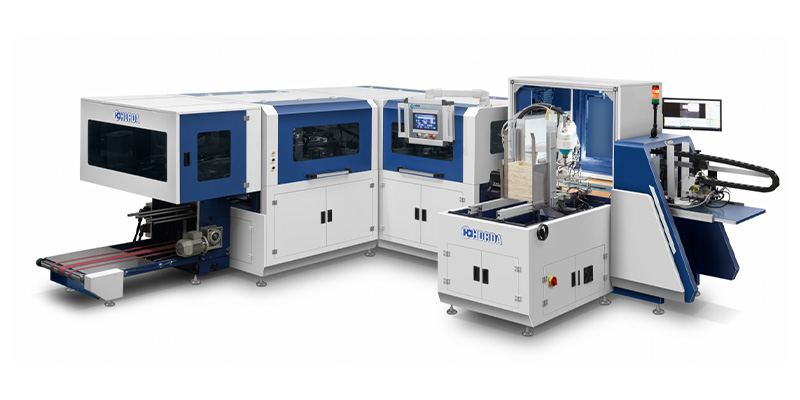
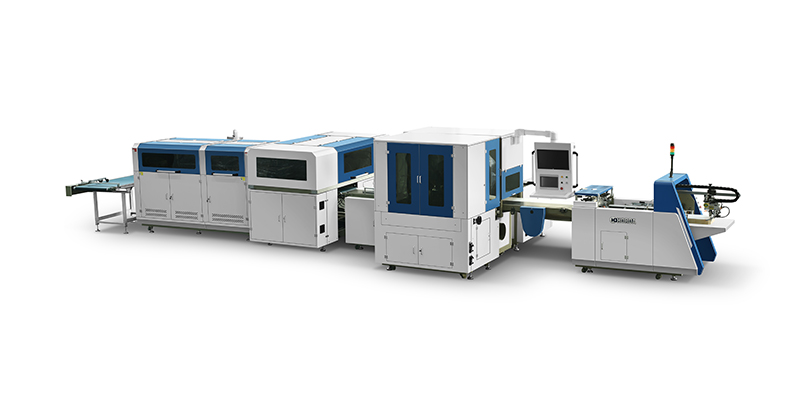
| Cover paper, boards and lining paper | Made and inner-lined case | Integrated case making and lining line | Case making, case transfer, lining paper feeding, gluing, positioning and pre-flattening |
| Completed case and inner paper | Inner-lined case | Case lining machine | Inner paper feeding, gluing, positioning, laminating and pre-flattening |
| Prepared boards and covering materials | Foldable box covers or wing structures | Foldable box making equipment | Cover making, wing positioning, folding or related structure-specific processes |
| Large board sheets or semi-finished cases | Prepared components or flatter finished products | Auxiliary equipment | Board slitting, spine cutting, angle cutting, punching or flattening |
Do not assume that the words “fully automatic” mean every production stage is included. Ask the supplier to show where raw materials enter, where manual handling remains and what leaves the proposed machine or line.
Choose the Right Machine Type
Automatic Case Maker
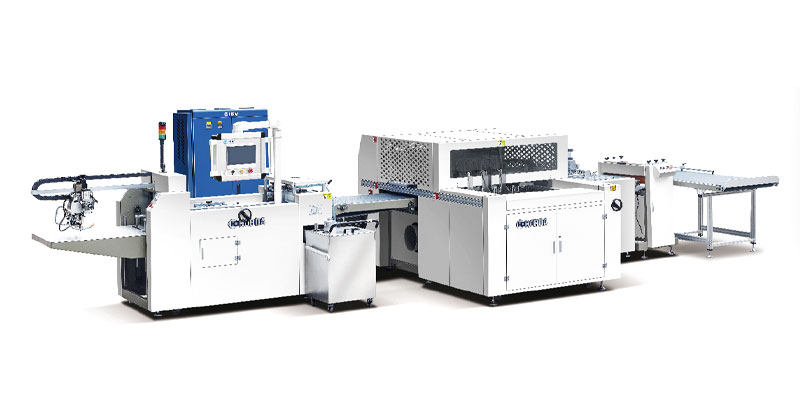
An automatic case maker is suitable when you need to make flat rigid cases from cover paper and board pieces. Depending on the model, the machine may automatically feed and glue the cover material, position one or more boards, fold the corners and turn in four edges.
This equipment direction is commonly used for hardcovers, book-shaped packaging, folders, game boards, calendar covers and other rigid cases. Standard, high-speed, round-corner and special-format models may have different working ranges and folding structures. Select the model from your real product portfolio rather than from the easiest sample.
Case Making and Lining Line
An integrated line connects case making with inner paper lamination. It can reduce the manual collection, turning and transfer required between the two operations. This direction is useful when both processes must run at similar volumes and the factory has enough repeat work to keep the connected line utilized.
Check the capacity balance between the case-making and lining sections. One section should not repeatedly wait for the other. You should also confirm how the line handles an abnormal stop, how work in progress is removed and whether either section can operate independently when required.
Case Lining Machine
A case lining machine is used when the outer case has already been made and inner paper must be applied to its inside surface. It is not a replacement for the earlier case-making process. The machine may feed the lining paper, apply glue, position the case, laminate the materials and perform pre-flattening.
This can be the more practical investment when the factory already has sufficient case-making capacity but still relies on manual inner lining. Match the lining machine to the output of the existing case maker so that one operation does not become a new bottleneck.
Collapsible Box Equipment
Collapsible rigid boxes require different board arrangements and assembly steps from standard flat hardcovers. Selection depends on the number and shape of the wings, the cover structure, the joining method and the amount of final manual assembly.
Provide both the flat structure and the assembled sample. A photo of the closed box is not sufficient because it does not show the wing arrangement, joints, gaps or adhesive areas that determine the machine process.
Auxiliary Equipment
Auxiliary machines are appropriate when one preparation or finishing step limits the entire workflow. Board slitting prepares sheets to the required width. Spine cutting prepares narrow board components used in cases and covers. Angle cutting creates the corner clearance needed for cleaner edge folding. Punching adds holes for products such as calendars, folders, tags or sample books. Flattening applies pressure after laminating or case making to improve bonding and reduce unevenness.
Purchasing one correctly matched auxiliary machine can be more useful than replacing an otherwise capable production line.
Check Production Volume
Production volume is an important selection factor, but there is no universal daily threshold that automatically separates semi-automatic and fully automatic equipment. Five hundred products across many short jobs can require more setup time than one thousand identical products in one continuous run.
Calculate the output you need from accepted products and net running time:
Required Gross Output per Minute = Target Accepted Output per Shift ÷ (Net Running Minutes × Expected First-Pass Yield)
For example, if your target is 6,000 accepted cases in a shift, net running time is 420 minutes and expected first-pass yield is 96%, the required gross output is approximately 14.9 pieces per minute. This is an illustrative calculation, not a machine guarantee.
Your capacity estimate should include:
- Working hours and shifts;
- Breaks, cleaning and scheduled maintenance;
- Typical batch size;
- Number of size or material changes per shift;
- Expected first-pass yield;
- Operator loading and inspection time;
- Capacity of the processes before and after the machine;
- Expected order growth over the planned equipment life.
Ask for sustainable output using your product, not only the maximum mechanical speed listed in a catalog.
Check the Size Range
Confirm the minimum and maximum dimensions for every product you intend to run. Do not rely on the overall category range because individual models can differ substantially.
For a case maker or lining machine, the relevant measurement may be the open flat case rather than the length, width and height of the assembled box. Ask the supplier which dimensions appear in the technical table and provide both finished and flat measurements.
Check all relevant dimensions:
- Finished product length, width and height;
- Open case length and width;
- Individual board length and width;
- Board thickness;
- Spine or gap width;
- Cover and lining paper dimensions;
- Wing dimensions for collapsible structures;
- Corner radius for round-corner products.
A product may fall within the overall length and width range but still be unsuitable because its board thickness, spine width, corner structure or paper allowance is outside the machine limits. Test your smallest, largest and most common products, including sizes close to the boundaries.
Confirm Material Compatibility
Material compatibility affects feeding, gluing, positioning, folding and surface quality. Two papers of the same weight may behave differently because of grain direction, coating, stiffness, curl or moisture.
Prepare the actual materials used in production and confirm:
- Board type, thickness, flatness and cutting quality;
- Cover paper type, weight and surface treatment;
- Lining paper type and weight;
- Use of specialty paper, synthetic paper, cloth or other flexible materials;
- Printed registration marks and surface protection requirements;
- Adhesive type, working temperature and viscosity range;
- Factory temperature and humidity where they affect paper and glue behavior.
Writing paper, coated paper, specialty paper, synthetic paper and cloth do not feed or absorb adhesive in the same way. A material that runs successfully during a short demonstration may still curl, slip or create bubbles during continuous production. Test the proposed feeder and glue system with production-grade materials.
If you use heated animal glue or an approved cold-glue process, confirm that the selected machine configuration supports it. Ask whether temperature or viscosity control is standard, optional or unnecessary for your adhesive.
Compare Positioning Systems
Positioning accuracy affects border consistency, printed image registration, spine alignment and the appearance of the finished case. The appropriate system depends on the product and artwork rather than on a general preference for the most advanced option.
| Positioning Direction | Suitable Conditions | Points to Verify |
|---|---|---|
| Mechanical positioning | Stable materials, simple products and less demanding print registration | Adjustment method, repeatability and sensitivity to board variation |
| Photoelectric detection with servo positioning | Automatic case making with detectable marks or edges and controlled board placement | Mark requirements, correction range and accuracy with actual printed sheets |
| CCD vision positioning | Printed covers, tighter borders, varied artwork, small products or structures needing more flexible registration | Camera recognition, lighting, surface reflection, repeatability and speed with your materials |
CCD vision may be valuable for premium cosmetic, electronics, gift and book-style packaging with visible printed borders. It is not automatically required for every product. Compare the accepted output and registration quality of the available systems using the same sample.
Do not approve positioning from one successful piece. Measure multiple products during a continuous run and check whether deviation increases after stops, restarts or material replenishment.
Check Changeover
Changeover flexibility can be more important than maximum speed when you produce many SKUs or short custom batches. Every size change removes time from production, and difficult adjustment can make output depend heavily on one experienced operator.
Ask the supplier to demonstrate a complete change between two of your real products. Record:
- Total time from the last accepted product of the first job to the first accepted product of the second;
- Number of mechanical adjustment points;
- Need for molds, fixtures or replacement parts;
- Availability of stored recipes or guided parameter settings;
- Materials consumed during setup;
- Skill level required from the operator;
- Cleaning required when paper or adhesive changes.
A fast machine with a long or inconsistent changeover may deliver less accepted output per shift than a slightly slower machine designed for frequent product changes.
Check Product Quality
Define acceptable quality before the trial. Terms such as “high precision” or “stable production” are not measurable acceptance standards.
Inspect the finished products for:
- Uneven printed borders or board position;
- Incorrect spine and gap spacing;
- Inconsistent edge turn-in;
- Loose corners or exposed board;
- Glue marks, overflow or insufficient bonding;
- Bubbles, wrinkles or trapped debris;
- Surface scratches and pressure marks;
- Warping after gluing and drying;
- Misaligned inner paper;
- Variation between the first and later products in the run.
Where possible, agree on measurable tolerances and a sampling method. The required standard should reflect the actual market for the product rather than an undefined promise of perfect quality.
Check Line Integration
A machine must fit the entire workflow, not only the process it performs. Review how board and paper are prepared, how work enters the machine and what happens to the output.
Check the following integration points:
- Board slitting, cutting or other upstream preparation;
- Printing direction and registration marks on cover paper;
- Manual or automatic transfer between machines;
- Orientation changes, turning devices and buffer areas;
- Capacity balance between case making, lining and later assembly;
- Space for material loading, cleaning and maintenance access;
- Electrical supply, frequency and compressed-air requirements;
- Handling of glue, waste board and cleaning water;
- Safe removal of products after a stop.
If you are adding equipment to an existing line, provide the upstream output dimensions, downstream input requirements and actual operating speeds. Two machines with similar catalog speeds may still require a buffer or manual transfer because their process cycles and product orientation differ.
Check Operation and Maintenance
Automation should reduce unnecessary manual work without making routine production difficult to manage. Ask how many people are needed for material loading, operation, inspection and collection during stable production.
Review daily cleaning, lubrication, glue-tank access, roller removal, sensor cleaning and replacement of normal wear parts. Confirm which faults the control system identifies, what information appears on the screen and which recovery steps operators can perform.
Also confirm the installation plan, operator training, production documentation, warranty scope, recommended spare parts and service response process. These items affect how quickly the machine reaches stable production and how long an unexpected stop may last.
Test Your Product
A sample-based production test is the most reliable way to confirm machine suitability. Use the same materials, dimensions and quality requirements planned for commercial production.
| Test Item | What to Record | Why It Matters |
|---|---|---|
| Product set | Typical, smallest, largest and most difficult products | Confirms the machine across the real order range |
| Continuous run | Run time, total output, accepted output, rejects and stops | Shows sustainable performance instead of short demonstration speed |
| Positioning | Measured deviation across multiple samples | Confirms repeatability with actual print and materials |
| Changeover | Time, adjustments, setup waste and first accepted product | Shows the effect of SKU changes on available capacity |
| Quality | Folding, bonding, surface, alignment and warping results | Confirms whether output meets the commercial standard |
| Stop and restart | Product handling, recovery time and material loss | Tests conditions that occur in normal factory operation |
| Cleaning | Time, access and required tools | Shows the recurring effect on labor and production availability |
Do not approve a machine from a few products made at maximum speed. A useful trial includes stable running, replenishment, changeover, stop recovery, quality inspection and cleaning.
Compare Machine Proposals
Ask every supplier to describe the proposed machine in the same format. This makes different configurations easier to compare and exposes missing processes or manual work.
- What exact product structure was used for the recommendation?
- Which processes are included and excluded?
- What materials and dimensions were tested?
- What sustainable accepted output was demonstrated?
- What positioning result applies to your sample?
- How long did the tested changeover take?
- How many operators and manual transfers remain?
- What optional modules, fixtures and glue systems are required?
- What factory utilities and floor space are needed?
- What installation, training, documentation and spare parts are included?
Machine suitability and project cost should be assessed separately. After confirming that two proposals can make the same products to the same standard, compare their total investment and operating impact. For the financial comparison, see the rigid box machine cost guide.
Choose by Production Scenario
| Production Scenario | Practical Direction | Main Selection Priority |
|---|---|---|
| Multiple hardcover sizes and frequent short runs | Flexible automatic case maker | Working range, changeover, recipe management and setup waste |
| Printed cosmetic or electronics packaging with narrow borders | Case maker with a suitable precision positioning system | Registration repeatability, surface protection and accepted output |
| Existing case-making capacity with manual inner lining | Standalone case lining machine | Capacity balance, material compatibility and lining accuracy |
| High-volume cases requiring inner lining | Integrated case making and lining line | Line balance, transfer stability, stop recovery and floor space |
| Collapsible gift, cosmetic or specialty boxes | Structure-specific collapsible box equipment | Wing arrangement, board pieces, adhesive areas and final assembly |
| One preparation or finishing step limits production | Targeted auxiliary equipment | Input and output match with the existing line |
Prepare Your Requirements
Send the following information before requesting a machine recommendation:
- Finished product photos and physical samples where available;
- Structural drawing or dieline;
- Finished and open dimensions;
- Minimum, maximum and typical product sizes;
- Board type, thickness and number of pieces;
- Cover and lining material specifications;
- Adhesive currently used;
- Required accepted output per shift or day;
- Typical batch size and number of daily changeovers;
- Current production process and main bottleneck;
- Required positioning and finished-quality standard;
- Destination country, voltage, frequency and available factory space.
This information allows the supplier to recommend equipment from a defined production problem instead of making assumptions from the phrase “rigid box machine.”
Frequently Asked Questions
What is the most important factor when choosing a rigid box making machine?
The most important factor is whether the machine performs the process required for your actual product structure. Start with the finished sample, required machine output, dimensions, materials and daily accepted output. Speed and price only become useful comparisons after the process scope is confirmed.
Should production volume alone determine the automation level?
No. Production volume should be evaluated together with batch size, SKU changes, labor, quality requirements and the surrounding workflow. A high-mix factory may value fast changeover and flexibility more than maximum speed, while a repeat-order factory may benefit more from an integrated automatic line.
Do I need CCD visual positioning?
CCD positioning is worth evaluating when printed registration, narrow borders, small products, varied artwork or irregular structures require more flexible alignment. Photoelectric and servo positioning may be sufficient for other products. Test both directions with your materials and compare repeatability, accepted output and changeover.
Can one machine make every rigid box style?
Usually not. Standard hard cases, round-corner covers, calendar covers, collapsible boxes and three-dimensional lid-and-base boxes can require different structures or additional processes. Confirm the exact machine input and output for each product instead of relying on a broad machine name.
What is the difference between a case maker and a case lining machine?
A case maker produces the outer rigid case by gluing cover material, positioning boards and folding the edges. A case lining machine applies inner paper to a case that has already been made. These processes can be performed by separate machines or connected in an integrated line.
How do I know whether my product fits the machine?
Compare the open case size, individual board dimensions, board thickness, spine or gap width, paper size and any structure-specific measurements with the selected model. Then run your smallest, largest and most difficult products during the sample test.
Can rigid box machines process specialty paper or cloth?
Some machines can process specialty paper, synthetic paper and cloth, but compatibility depends on the feeder, glue system, surface friction, material stiffness and selected model. Supply the actual material for testing instead of confirming suitability from the material name alone.
How should I verify the advertised machine speed?
Run a continuous test with your production materials and record total output, accepted output, rejects, stops and net running time. Also test material replenishment and a normal size change. This gives you a more useful sustainable output than a short run at maximum mechanical speed.
Make the Final Choice
The right rigid box making machine is the one that completes the required process, fits your full product and material range, produces enough accepted output and integrates with the rest of your factory. Begin with the product structure and current bottleneck. Then compare size, materials, positioning, changeover, quality and sustainable output using the same samples and acceptance criteria.
A machine with a higher maximum speed is not automatically the better choice. For high-mix production, flexibility and changeover may create more usable capacity. For repeat high-volume orders, process integration and stable continuous output may matter more. A sample-based production test is the clearest way to turn catalog specifications into a practical purchasing decision.
Get a Machine Recommendation
Send HORDA your product photos, structural drawing, dimensions, board and paper specifications, daily output target and current production process. Our team will identify the required operations and recommend a suitable standalone machine or connected solution for your production needs.
Send Your Product Details